




Measuring the leakage
Do you need to verify that your newly installed HVAC system meets the designed airtightness class, or are you looking for ways to reduce operating costs? We will test the airtightness of your system, pinpoint any leakage areas, and issue an official protocol that fully complies with engineering standards and project handover requirements.
When and how is HVAC testing and validation performed?
HVAC ductwork leak testing and validation can be performed during various stages of construction and building operation. This includes quality control checks during the installation of new ductwork, quality verification for construction management or the investor’s technical supervisor, as well as during the refurbishment or retrofit of air handling units (AHUs).

In-Construction Quality Control
We test designated inspection sections to verify the quality of the installation.

Validation Prior to Final Inspection
We verify HVAC airtightness and issue an official protocol for construction management or the investor.

System Retrofits and Refurbishment
We determine system parameters prior to commencing the retrofit.
How the Testing Works
For airtightness testing of HVAC systems, we use certified instruments with laboratory calibration. The device is connected to a designated ductwork section, typically spanning several dozen square meters. The section is then pressurized to the operating pressure (e.g., 250 or 400 Pa), and air leakage is measured over a 5-minute period. These leak rates are subsequently converted into a leakage percentage and the corresponding airtightness class in liters per second.
Testing is standardly performed in compliance with applicable engineering standards. Based on the overall size of the building, we select several ductwork sections for validation. We rarely test just a single section, ensuring we can accurately extrapolate the measured data across the entire system.
Key Considerations
- We use calibrated and certified instruments
- Airtightness is tested in compliance with applicable standards
- We provide a protocol that clearly states the measured values and results
- If necessary, we propose corrective measures to remedy excessive leakage rates
01 Testing of Small-Scale Systems
For airtightness testing of small-scale systems up to 20 m², we utilize the Wohler DP700, which provides the high sensitivity required to detect even minor leak rates down to units of liters per second. These types of leaks frequently occur, for example, in apartment building risers.
Request Testing02 Testing of Large-Scale Systems
If you need to test the airtightness of a large section or an entire system—for example, prior to a retrofit or refurbishment—we utilize the Euroseal system. It is capable of pressurizing several hundred square meters of ductwork or measuring substantial leak rates in smaller sections. Equipped with a high-capacity fan, it can accurately measure air leakage even when it reaches dozens of percent of the total air volume.
Request Testing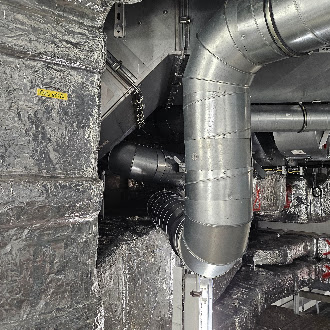 02
0203 Protocols and Recommendations
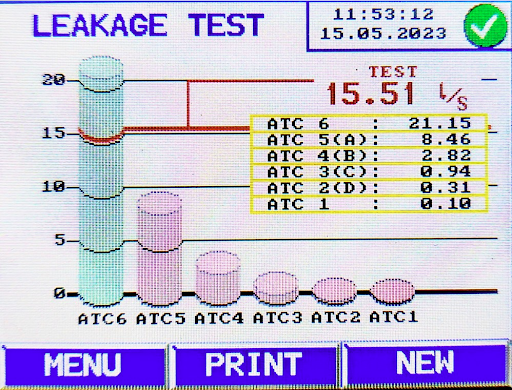
Following the testing, we will provide you with a detailed protocol that clearly specifies the size of the tested section and the extent of the leakage. This data includes leak rates in liters per second, leakage percentages, and a conversion into the total leakage area.
The leakage percentages and liters per second clearly demonstrate the measured airtightness class. Meanwhile, the conversion into the total leakage area in cm² provides a clear visual illustration of the magnitude of the issue within the HVAC system.
 03
03Our Experience




FAQ
Didn’t find what you were looking for? Check out our FAQ, or give us a call or send us an email right away!
Are there any laws or standards that require the cleaning of ventilation ductwork?
There is a non-binding technical standard, EN 15780, which addresses the cleanliness of ventilation ductwork in residential areas, and we strictly follow it in our projects. However, there is currently no legally binding regulation that mandates duct cleaning.
Do you hold any certifications as proof of expertise?
Yes, we hold the international ASCS (Air System Cleaning Specialist) certification, awarded by the North American association NADCA (www.nadca.com). We also hold a certificate from the German Association of Engineers (Verein Deutscher Ingenieure), specifically VDI 6022-B, which also defines the methodology for ventilation ductwork cleaning.
Is it possible to perform duct disinfection without prior cleaning?
Disinfection is only effective when performed on clean surfaces. If a surface—such as the inside of a duct—is contaminated, the disinfection will not achieve the desired effect, as bacteria or viruses can survive deeper within the debris. Therefore, performing disinfection without prior cleaning is only feasible in newly constructed buildings up to approximately 10 years old; otherwise, we strictly recommend cleaning before applying any disinfectant.